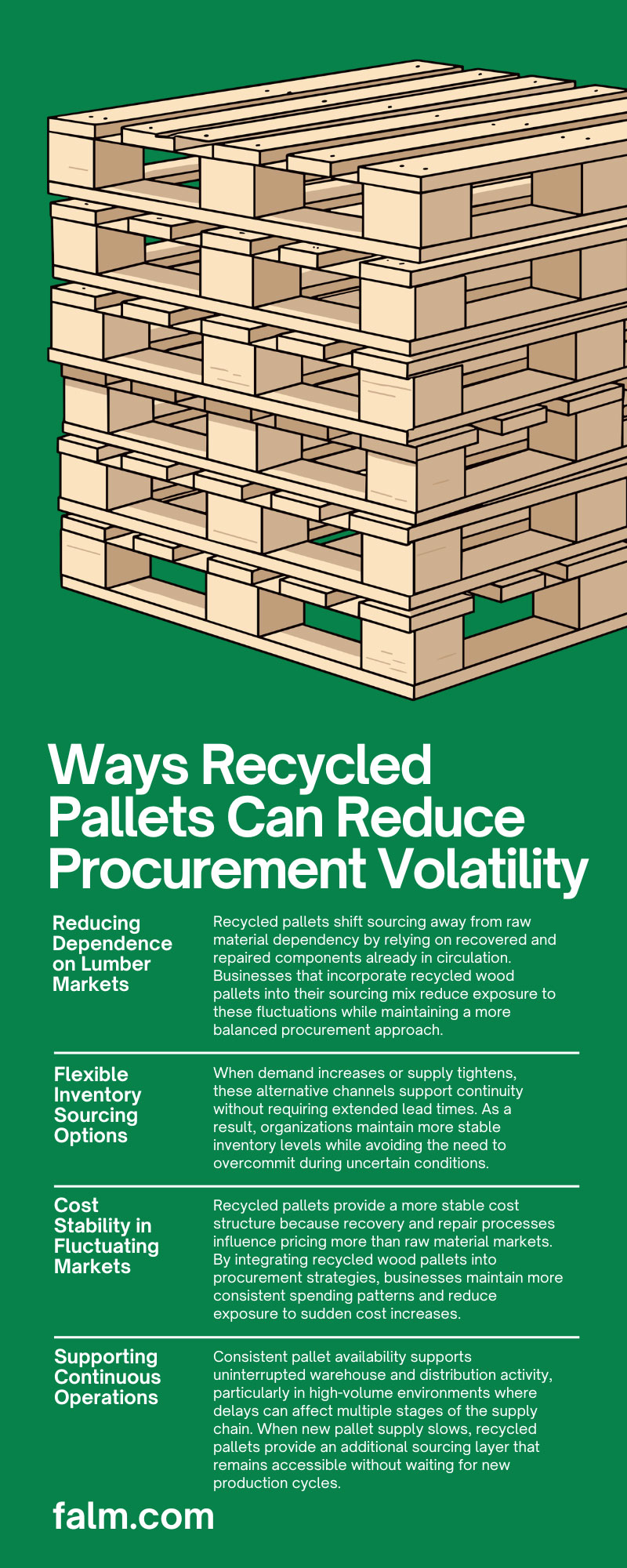

Procurement teams face constant pressure from shifting material costs, uneven supply conditions, and changing operational demands, all of which create instability in pallet sourcing. When availability tightens or pricing fluctuates, businesses struggle to maintain consistent inventory levels, especially across multiple facilities with different throughput needs.
Understanding ways recycled pallets can reduce procurement volatility requires examining how alternative sourcing methods create stability within changing market conditions. By incorporating recycled options into procurement strategies, organizations gain more control over supply while maintaining steady access to pallet inventory.
Reducing Dependence on Lumber Markets
Lumber pricing directly influences new pallet production, and those price swings can quickly affect procurement budgets and availability. When lumber supply tightens or costs rise, pallet lead times increase and pricing becomes harder to predict, which complicates sourcing decisions.
Recycled pallets shift sourcing away from raw material dependency by relying on recovered and repaired components already in circulation. Businesses that incorporate recycled wood pallets into their sourcing mix reduce exposure to these fluctuations while maintaining a more balanced procurement approach.
Flexible Inventory Sourcing Options
Recycled pallet programs expand sourcing channels by incorporating recovered, repaired, and reconditioned inventory into the supply stream. This approach allows procurement teams to adjust volumes based on real-time availability instead of relying on a single production pipeline.
When demand increases or supply tightens, these alternative channels support continuity without requiring extended lead times. As a result, organizations maintain more stable inventory levels while avoiding the need to overcommit during uncertain conditions.
Cost Stability in Fluctuating Markets
Market-driven pricing changes create challenges when procurement teams need predictable budgets. New pallet costs move in direct response to lumber pricing, which introduces volatility into purchasing decisions.
Recycled pallets provide a more stable cost structure because recovery and repair processes influence pricing more than raw material markets. By integrating recycled wood pallets into procurement strategies, businesses maintain more consistent spending patterns and reduce exposure to sudden cost increases.
Supporting Continuous Operations
[Image A]
Consistent pallet availability supports uninterrupted warehouse and distribution activity, particularly in high-volume environments where delays can affect multiple stages of the supply chain. When new pallet supply slows, recycled pallets provide an additional sourcing layer that remains accessible without waiting for new production cycles.
This added flexibility allows operations to continue without disruption, even when primary supply channels experience delays. Procurement teams that include recycled options create a buffer that strengthens overall supply continuity while maintaining workflow stability.
Integrating Recycled Pallets Into Procurement Strategy
Effective procurement strategies require alignment between sourcing decisions, inventory management, and operational requirements. Recycled pallets function best when businesses treat them as a consistent component of their sourcing model.
Blending recycled inventory with new pallets allows procurement teams to shift sourcing based on current conditions while maintaining overall supply balance. Supporting both short-term adjustments and long-term planning without sacrificing consistency.
Blended Pallet Programs
Blended programs combine new and recycled pallets to create a sourcing structure where each type serves a defined role. This model allows businesses to match pallet types to specific applications while maintaining steady availability across changing demand levels.
Adapting to Regional Supply Variability
Regional differences in manufacturing output, pallet recovery rates, and transportation access create uneven supply conditions across geographic areas. Businesses that rely on a single region increase their exposure to localized disruptions or demand spikes.
Recycled pallet networks draw from broader recovery streams, which span multiple regions and provide greater sourcing flexibility. Procurement teams that leverage these networks can shift sourcing locations as conditions change, which reduces dependence on any single area while improving responsiveness and supply continuity.
Strengthening Supplier Network Resilience
Strong supplier networks support procurement stability by providing multiple sourcing options instead of relying on a single manufacturer. Recycled pallet programs typically involve collection, repair, and redistribution partners, which creates a more distributed supply structure.
When one source faces constraints, other partners within the network can supply inventory, allowing businesses to maintain continuity. This diversified approach reduces risk and supports more consistent pallet availability across operations, particularly during periods of market uncertainty and shifting demand patterns.
Reducing Exposure To Demand Spikes
[Image B]
Sudden increases in demand can strain traditional pallet production, especially when manufacturers cannot scale output quickly enough to meet short-term needs. Recycled pallets offer a more responsive option because facilities process and redistribute recovered inventory faster than newly manufactured pallets.
This responsiveness allows procurement teams to meet demand spikes without committing to long-term purchasing increases. As a result, businesses maintain flexibility while avoiding the challenges associated with supply shortages, delayed fulfillment, or unnecessary excess inventory.
Aligning Pallet Sourcing With Forecasting Models
Procurement volatility increases when sourcing decisions operate separately from demand forecasting, which creates gaps between expected and actual inventory needs. Businesses that align pallet sourcing with forecasting models can anticipate demand changes and adjust supply before disruptions occur.
Recycled pallet programs add flexibility to this process because they scale more easily than production tied to raw material constraints. Integrating recycled options into forecasting strategies allows procurement teams to respond to demand variability with greater precision, improving planning accuracy, and inventory control.
Tracking Pallet Flow To Improve Procurement Decisions
Procurement stability improves when businesses track how pallets move through their operations, including usage rates, return cycles, and loss points. Without this visibility, sourcing decisions rely on estimates, which increases the risk of overordering or shortages.
Recycled pallet programs support tracking and recovery processes, which provide better insight into pallet lifecycle performance. This visibility allows procurement teams to refine sourcing volumes, reduce unnecessary purchases, and maintain a more controlled and predictable inventory position.
Long-Term Supply Planning Considerations
Long-term supply planning requires anticipating changes in demand, material availability, and operational growth. Procurement teams that include recycled pallets in their planning create additional flexibility that supports stable sourcing.
This allows businesses to adapt to changing conditions without restructuring their entire sourcing strategy. Incorporating recycled options strengthens resilience while supporting consistent pallet availability across evolving operational requirements and supply chain demands.
Create a More Resilient Pallet Procurement Strategy
Reducing procurement volatility requires a sourcing strategy that accounts for market fluctuations while maintaining consistent access to pallet inventory. Recycled pallets provide flexibility, cost stability, and diversified supply channels that support more predictable procurement outcomes.
Understanding ways recycled pallets can reduce procurement volatility allows businesses to build sourcing strategies that remain stable under changing conditions. Companies can work with First Alliance Logistics Management to incorporate recycled wood pallets into procurement programs that support consistent supply, improved planning accuracy, and long-term operational performance.